close









What Is the Language of Your Best Self?
Optimal Thinking has been hailed by academia and the media as “the successor to positive thinking” and “the basis of best practices and peak performance.” Here, its creator, Rosalene Glickman, Ph.D., answers the questions she is asked most.
In This Interview
Optimal Thinking is the language of your best self. It stops you from settling for second best. It is the “mental software” for personal and professional optimization.
Optimal Thinking stops you from settling for second best.
We are all Optimal Thinkers. Some of us use Optimal Thinking from time to time, others use it more frequently, but most people don’t use it consistently.
Since 1980, I have presented seminars in corporations and educational organizations and to individuals throughout the world. I quickly realized that the “think positive” motto had serious shortcomings. Statements such as “fake it till you make it” and “stay away from negativity” did not seem right to me.
During the eighties, peak performance and continuous improvement were the buzz phrases. Many corporate consultants claimed that if we think positively; display courage, persistence, and self-reliance; and use their suggested techniques for setting goals, managing time, and relating to others, peak performance is achieved. While such qualities and techniques are certainly constructive ingredients for success, what is essential for peak performance is peak or Optimal Thinking. Our performance is always compromised if we think in only moderate or even extraordinary terms. Being good or even great is not the foundation of peak performance.
I asked myself: Why settle for continuous improvement? What would it take to create continuous optimization? I then began to formulate Optimal Thinking. My goal was to provide the mental software for peak performance and continuous optimization.
Why settle for continuous improvement?
What would it take to create continuous optimization?
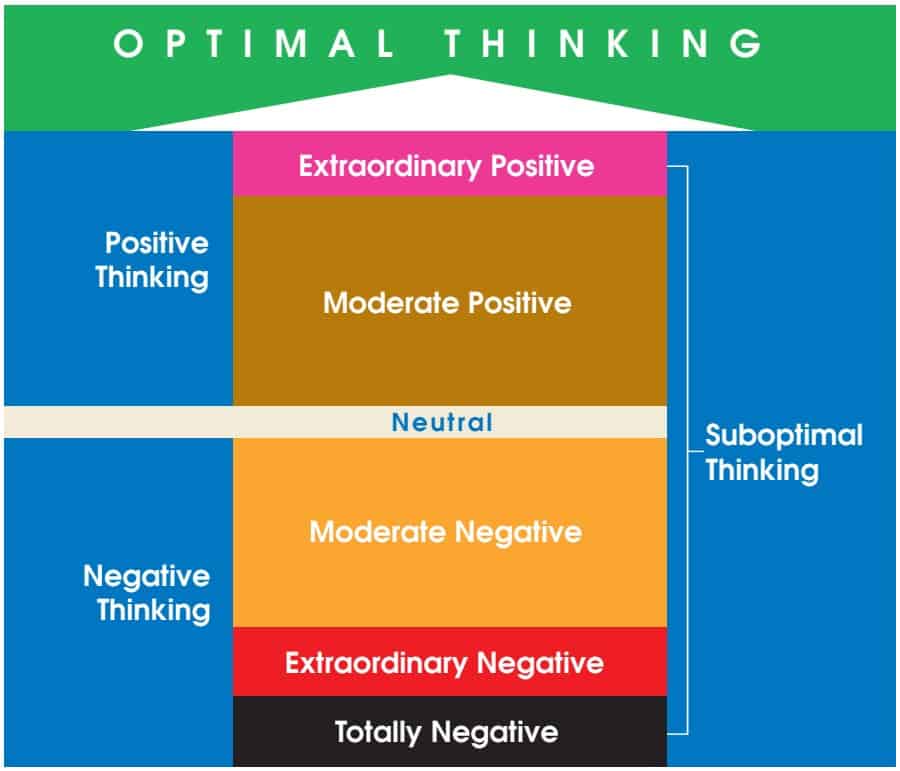
1. Positive thinking is often used to suppress negativity. Many positive thinkers want to hear only the good news and alienate themselves from any negative thoughts or feelings. Optimal Thinkers understand that negative thinking is valuable. It cautions us against imminent danger and is necessary in any design process to point out the flaws so that they can be rectified. For Optimal Thinkers, negativity serves as a signal to optimize.
2. Positive thinking is often no more than wishful thinking. When the cost of failure is high, optimism is the wrong strategy and can even be disastrous. Instead of hoping for the best, Optimal Thinkers examine the problem, select the best solution from realistic alternatives, and create contingency plans. Optimal Thinking is Optimal realism.
3. There are varying shades of positive thinking. For example, moderate positive thinkers manage situations and seek good results. Extraordinarily positive thinkers seek extraordinary or great results. The moderate positive thinker acts as a wet blanket to the extraordinarily positive thinker, who is the energizer. These people are on different wavelengths and their different levels of thinking are not harmonious. In contrast, Optimal Thinking provides the common form of thinking that empowers us to be our best and communicate at our peak.
4. Suboptimal thinking is not the mental basis of peak performance. We can’t function at our peak when we think in suboptimal terms. Every time we think suboptimally, we compromise performance and results. Optimal Thinking is the mental basis of peak performance.
5. If we don’t optimize a situation, we don’t complete it. When we merely manage or improve situations, we rarely experience complete satisfaction because the unexplored options remind us that we have settled for second best. Optimal Thinkers explore their options, choose the best, then put their issues to rest.
Optimal Thinking empowers you to be your best regardless of the circumstances. By asking the best questions of yourself and others, you invite the best solutions and stop settling for second best. You define what “the best” means to you and what is most important in your life. You eliminate self-sabotage, optimize your talents, resources, opportunities, motivation, and time. You maximize your enjoyment of daily activities, stop unwanted behaviors, and bring out the best in others. In short, you optimize your mental, emotional and financial intelligence, and you function at your peak.
Optimal Thinking is the vehicle to achieve peak performance and continuous optimization. With Optimal Thinking, you discover how your team, department and company can have the greatest impact in the marketplace. You surround yourself with the right people (where possible) and you create a direction for your organization where it can be the best, and the most profitable. You formulate the most effective strategic plans and take the best actions to achieve your objectives. Reachable goals and optimal conditions are established to motivate everyone to do his or her best.
In the Optimal Thinking business paradigm, all employees are optimizers. They are educated in the art of Optimal Thinking. They make the best use of their talents, abilities, resources and opportunities. They ask the best questions of themselves and others to obtain the best solutions. They focus on the most desirable outcomes and contribute their best. Optimizers resolve interpersonal conflicts as they occur with Optimal Thinking, and they contribute their best efforts in a cohesive, accountable team to achieve the corporate mission. They sweep past the bad, good and even the great into the realm of the highest and best!
Many people unknowingly sabotage the best interests of their company by settling for second best in the present moment. When faced with distressing life situations, they are overpowered by disturbing emotions and may even focus on what is out of their control. By choosing suboptimal thinking instead of Optimal Thinking, they block themselves and their team from the opportunity to be their best and are unable to create the best results.
Many companies are still committed to the old positive thinking paradigm and are unaware of the power of Optimal Thinking. They do not understand how easy and rewarding it is to create a culture of optimization. They believe that being great is good enough.
In Execution, Larry Bossidy and Ram Charan write: “Organizations don’t execute unless the right people, individually and collectively, focus on the right details at the right time.” In Good to Great, Jim Collins states that great companies determine what thing at which they can be best in the world. Clearly, Optimal Thinking is essential to achieve these objectives. When a team of optimizers executes the best vision, companies can take the ultimate quantum leap from Bad to Best, Good to Best and Great to Greatest.
The Optimal Thinking 360 Assessment captures and analyzes company-wide thinking patterns to provide new insights into corporate strengths, gaps and specific areas for optimization (personal and professional information remains strictly confidential).
Optimal Thinking is best implemented when leaders commit to the optimization process. When every employee becomes an optimizer, the company experiences the benefits of critical mass. You can introduce Optimal Thinking into your company by optimizing yourself and your team. Other teams and departments will notice your results and will want to duplicate them. Optimal Thinking can then flow through your organization.
A team of Certified Optimal Trainers and myself consult with leaders and human resource experts to develop an Optimal strategic plan for implementation based on your company’s specific needs. We provide Optimal Thinking training programs, resources, products and services for your entire organization.
Your Next Step
Experience the Language of Your Best Self
Discover how much of your thinking is in your best interest, then make Optimal Thinking your daily habit in 100 days.
Rosalene Glickman, Ph.D. is the creator of Optimal Thinking and best-selling author of Optimal Thinking (Wiley, 7 printings, 17 languages), hailed by academia and the media as “the successor to positive thinking” and “the basis of best practices and peak performance.” She has provided more than 32,000 hours of one-on-one coaching to Fortune 500 and YPO leaders. Based on those hours, Optimal Thinking Executive Coaching averages 11.98x ROI in 12 months.
Her clients include Johnson & Johnson, the U.S. Army, Delta Air Lines, Coca-Cola, BP, Bristol-Myers Squibb, Warner Bros., Red Bull, the Internal Revenue Service and the Young Presidents’ Organization. She has been featured on Bloomberg TV, Fox News Channel and CBS Weekend Magazine and in USA Today, Inc. magazine, Government Executive Magazine and Association Management Magazine.
Dr. Glickman has been repeatedly honored by the media as “Australia’s most successful woman.” She is the recipient of the “Woman of the Year” award for National Business Women’s Week in Hollywood, was nominated for The Order of Australia, and has ranked within the top 20 global personal development experts for 25 years. She holds a Ph.D. in Psychology and lives in Los Angeles.

Faced with tough workplace challenges? Ready to optimize your leadership and performance?
Optimal Thinking Executive Coaching averages 11.98 x ROI in 12 months.





Comments are closed.